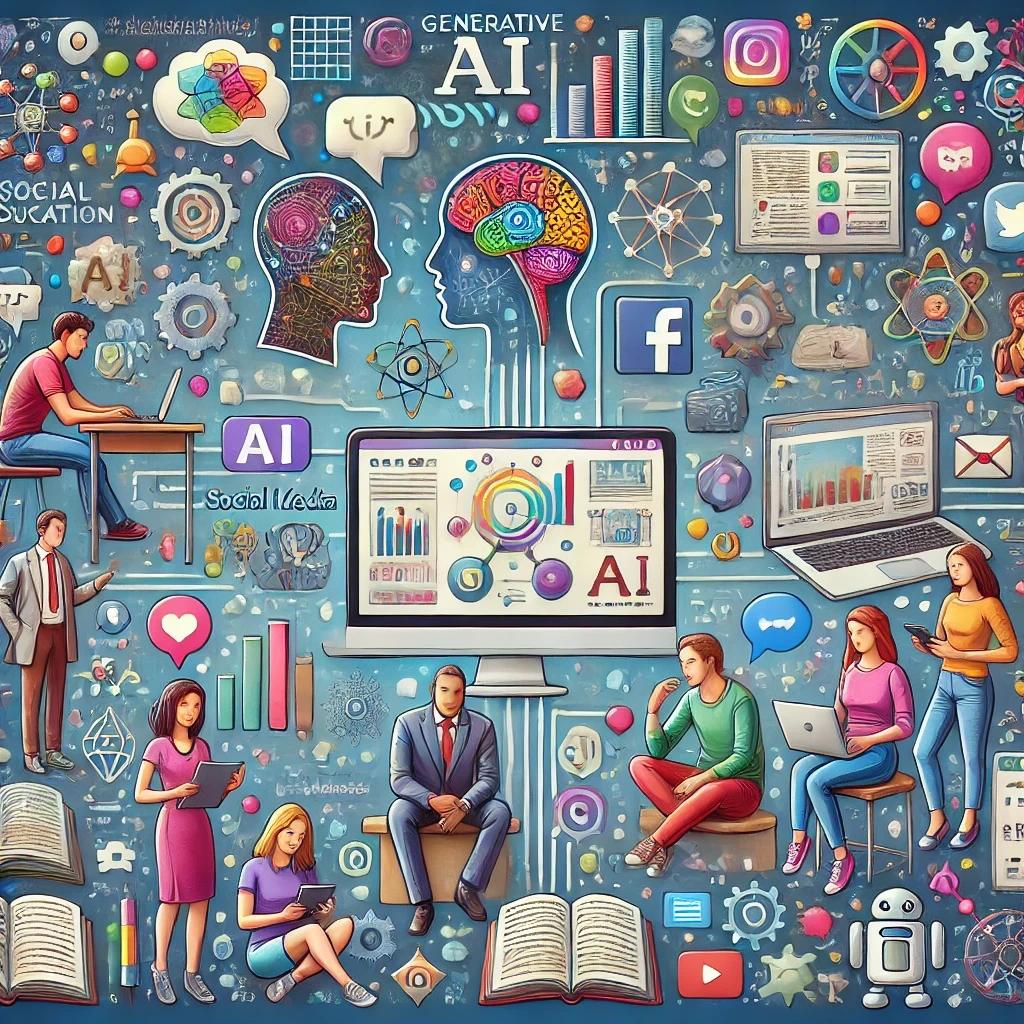
Image created using DALLE
Generative AI (GenAI) can provide inspiration and ideas to help both higher education students and educators to enhance their use of social media for academic, professional, and personal use. As with any use of GenAI, it is very important to check the information it provides and to use these tools responsibly and ethically.
See the GenAI CHECKLIST at the bottom of the post for further guidance on using Generative AI.
Here are some suggestions for ways this technology can be used.
Students’ Use of Social Media
Building a Personal Brand:
GenAI can guide students in creating their professional online profiles, suggesting content to share, how to write engaging descriptions, and how to build an academic persona that attracts attention from potential employers or collaborators. GenAI could also provide suggestions of ways to present a professional profile bio.
Professional Networking:
GenAI can recommend professionals or alumni in the students’ field of study to connect with, helping them expand their networks through platforms like LinkedIn. It can also suggest ways to engage with them, such as commenting on posts or sharing relevant articles.
Finding Relevant Academic Communities:
AI-powered social media tools can suggest relevant academic groups, conferences, or discussion boards based on students’ interests and academic focus. It could also recommend hashtags, academic journals, or thought leaders to follow.
Social Listening for Trends:
For students in fields like business, technology, or digital media, GenAI can track trends and emerging topics on social media, helping them stay informed and ready to engage in relevant academic discussions.
Content Generation for Portfolios:
GenAI can assist students in generating structures for case studies or research summaries to showcase their skills on social media platforms like LinkedIn or Medium.
Visual Learning Aids:
Students can create engaging visuals like infographics, diagrams, or mind maps using GenAI to present complex ideas in a simple way, enhancing both their own understanding and that of their peers. For example, GenAI could help students generate charts or illustrations to visually represent research findings in a LinkedIn post.
Academic Blog Posts:
GenAI can assist students in developing ideas and tips for writing blog posts. This can help them to articulate their thoughts, and then back this with evidence. GenAI could create an image for the post heading.
Study Resources and Summaries:
GenAI can help students quickly generate summaries of academic materials, articles, or notes, which once checked could be shared on social media study groups or academic forums within their course VLE (virtual learning environment).
Group Projects and Collaboration:
GenAI can generate outlines or recommendations for group projects, making it easier to divide tasks among students in social media groups or messaging platforms.
Educators’ Use of Social Media
Educational Content Creation:
Educators can use GenAI to create teaching materials, such as short explainer videos, lecture slides, quizzes, or study guides. GenAI tools can format content for social media platforms like LinkedIn, Instagram, Twitter/X, or YouTube.
Automated Summaries of Lectures:
After delivering a lecture, educators can use GenAI to generate summaries or discussion prompts that can be posted on social media platforms to encourage student engagement and further discussions.
Course Promotion:
GenAI can generate tailored promotional content for online courses, webinars, or academic events, helping educators reach a broader audience on social media. It can identify keywords and generate attention-grabbing visuals.
Connecting with Other Educators:
GenAI can help educators find and connect with peers in their field. It can recommend relevant academic forums, conferences, or groups to join, facilitating knowledge exchange and collaboration.
Research Dissemination:
GenAI tools can assist educators in converting complex academic papers into more digestible formats like Twitter/X threads, blog posts, or LinkedIn articles, making research more accessible and engaging to broader audiences.
Institutional Use of Social Media
Institutional Branding and Outreach:
Universities can leverage GenAI to produce compelling content (videos, infographics, blog posts) that promote courses, events, or new initiatives. GenAI can help identify the target audience and suggest the most effective messaging for recruitment campaigns on platforms like LinkedIn, Instagram, and Twitter/X.
GenAI-Generated Campus Tours or Q&A Sessions:
GenAI can help institutions create virtual campus tours or automate live Q&A sessions on social media platforms, offering prospective students an interactive way to learn about courses and university life.
Knowledge Sharing and Open Educational Resources:
Universities can use GenAI to create and distribute open educational resources (OERs) on social media platforms, providing inclusive access to high-quality education. GenAI could adapt lecture notes or research into formats suitable for wider audiences.
Online Learning Communities:
Institutions can use GenAI to support the use of online learning communities on social media platforms, where students and educators from across the globe can interact, share resources, and discuss academic topics.
Social Media Analytics
AI-powered analytics can help institutions and educators understand which social media posts resonate most with students. This data can guide future content strategies, ensuring higher engagement and outreach success.
Tracking Academic Trends:
GenAI can analyse data from academic social media platforms like ResearchGate or Academia.edu to identify emerging research trends, topics of interest, and influential publications, helping institutions stay at the forefront of academic discourse.
Research Promotion and Public Engagement
Presenting Academic Work for Public Audiences:
GenAI can assist in simplifying complex research papers, turning them into accessible content (videos, podcasts, blog posts, or social media posts) that can be shared with the broader public, explaining academic concepts to a non-expert audience.
Research Highlights:
GenAI tools can generate succinct key takeaways or graphical abstracts from research papers, making it easier for educators and researchers to share their work on platforms like LinkedIn, Twitter/X and Bluesky.
Crowdsourcing and Public Involvement:
GenAI-powered social media tools can help educators and students (with ethical approval) develop surveys or draft messages to crowdsource opinions and ideas on academic topics, engaging the public in meaningful ways and enriching research projects.
Challenges and Considerations in Higher Education Context
Academic Integrity:
AI-generated content should be used responsibly, especially by students, to avoid issues of plagiarism or over-reliance on AI for assignments and projects. Clear guidelines need to be set on how students can use GenAI tools ethically.
Deepfakes and Misinformation:
Educators must teach students to critically evaluate AI-generated content, as the rise of deepfakes and AI-generated misinformation on social media poses challenges for both academic and personal integrity.
Balancing Automation and Authenticity:
Both students and educators should ensure that while they leverage AI for efficiency, they don’t lose the personal touch in academic interactions or networking.
Summary
Generative AI offers a multitude of opportunities to enhance the social media experience in higher education, from helping students create meaningful content to allowing educators to share and promote their work more effectively. When used responsibly and ethically, these tools can foster collaboration, support learning, and engage broader audiences in academic discourse.
The GenerativeAI CHECKLIST below can be used to consider when and how GenAI is used.
Beckingham, S. and Hartley, P. (2024). The Generative AI CHECKLIST. National Teaching Repository. Educational resource. https://doi.org/10.25416/NTR.27022309.v1

 Sue Beckingham