

As students return to university many will be looking to apply for either industry placements or graduate roles. For second year students a placement is usually an opportunity to take a year out before the final year of their degree to work for an organisation to gain valuable experience. They are also known as a sandwich year or year in industry. For final year students there may be graduate training schemes where employers are specifically looking to recruit university students.
A report commissioned by University Alliance, CBI Economics (2024) conducted a survey of 252 UK employers across all business sectors, sizes and regions. This found that the most important factors in determining graduate success on the jobs market are:
- Enthusiasm for the role they apply for (important to 68% of employers)
- Transferrable skills such as communication (important to 55% of employers)
- Graduates with degrees that include vocational experience as part of their course (such as internships, placement years or employer-informed projects at university) were deemed to have substantially better performance throughout the recruitment process. 85% of employers believed vocational experience enhanced performance at interview.
Professionalism and online presence
Having a professional online presence is crucial. This means taking time to ensure old social media profiles that are no longer used are deleted. Being aware that any search engine can pull out public posts on social media channels.
What is a Professional Online Presence?
Simply put, this is the collective existence online of any individual (or organisation). This may be as a result of having a presence on a website, social networking site or other digital space; having a profile within that space; or interacting with the online presence of others.
A professional online presence refers one’s online existence in a professional context, and also gives consideration to conducting oneself professionally within any online space. Having a negative or improper online personal presence can have a damaging effect on one’s professional reputation and digital identity. (Beckingham, 2019)
What are employers looking for?
Within job adverts there will be a collection of key essential skills you must be able to demonstrate and often desirable skills the employer is looking for. Applicants will need to demonstrate each of these in a CV and/or application form, with concrete examples. It is highly likely applicants will be asked to expand upon these if invited for an interview. Employers may also ask applicants to inlcude a URL link to their LinkedIn profile.
Skills
Skills may be referred to in a variety of ways. For example transferable ‘soft skills’ are also referred to as people skills, human skills, generic skills and baseline skills and ‘hard skills’ as technical skills, discipline skills, specialist skills and practical skills. (Beckingham, 2023b).
The STAR method (National Careers Service, nd) is a useful way to showcase skills and experience on your LinkedIn profile as well on a CV and/or job application forms.
STAR stands for:
Situation – the situation you had to deal with
Task – the task you were given to do
Action – the action you took
Result – what happened as a result of your action and what you learned from the experience
It is important to present authentic examples and to explain what you did, how you did it, and why you did it.
An additional R is Reflect. Here you may want to reflect on:
- Why has your experience made you want to apply for [add job role]?
- Through your experience, what have you learnt about [add industry] and a career in [discipline]?
- How will the skills you’ve gained make you a suitable person for [add role]?
You can find further tips on reflection here: https://project-based-learning-toolkit.com/reflection-toolkit/
Why is a LinkedIn profile important?

A LinkedIn profile is essential for students and all job applicants as it serves as a digital CV and portfolio, can help to build a professional network, increases visibility to recruiters and employers, and provides a platform for finding internships and job opportunities. Staying active on Linkedin provides the opprtunity to showcase skills, engage with industry professionals, make connections and gain advice.
Placement and graduate recruiters may use LinkedIn to search for potential candidates for the roles they seek to fill. Having a polished and detailed profile can help recruiters find the people they are looking for and verify skills and experience candidates inlude in CVs and applications forms.
How to make your LinkedIn profile stand out
Preparation is key and proofreading what you add to your profile (or better still ask a friend to check it too). Writing in the first person is recommended. Complete all of the required sections and add a photo to your profile. This not only helps potential connections identify you with your name, profiles with a photo are regarded as more trustworthy. A good ‘head and shoulders’ photo can easily be captured by a friend on a mobile phone. Ideally have this taken against a plain backdrop – a white wall is ideal. You can also add a background photo that appears at the top of your profile that reflects your interests.
It should go without saying but adding your current and/or completed degree course and work experience is important. Below are some additional sections to focus in on, which will help to make your profile stand out.
Heading and customised URL
Create a catchy headline (the section at the top of your profile) that clearly states who you are and what you are looking for in your career. Edit to say you are looking for a placement or a graduate role. Personalise your public profile’s URL for a more professional appearance.
Skills
Adding skills to your profile can help employers looking for graduates and placement students find you. Yes employers will use the search function in LinkedIn! The detailed information can go in the ‘About’ and ‘Experience’ sections. Make use of the STAR statement approach. There is a also a specific section to add discipline, technical and soft skills you feel you can demonstrate. Be strategic and add the ones you know are relevant to the industry you wish to work in. Over time you will need to revisit this section and add new skills.
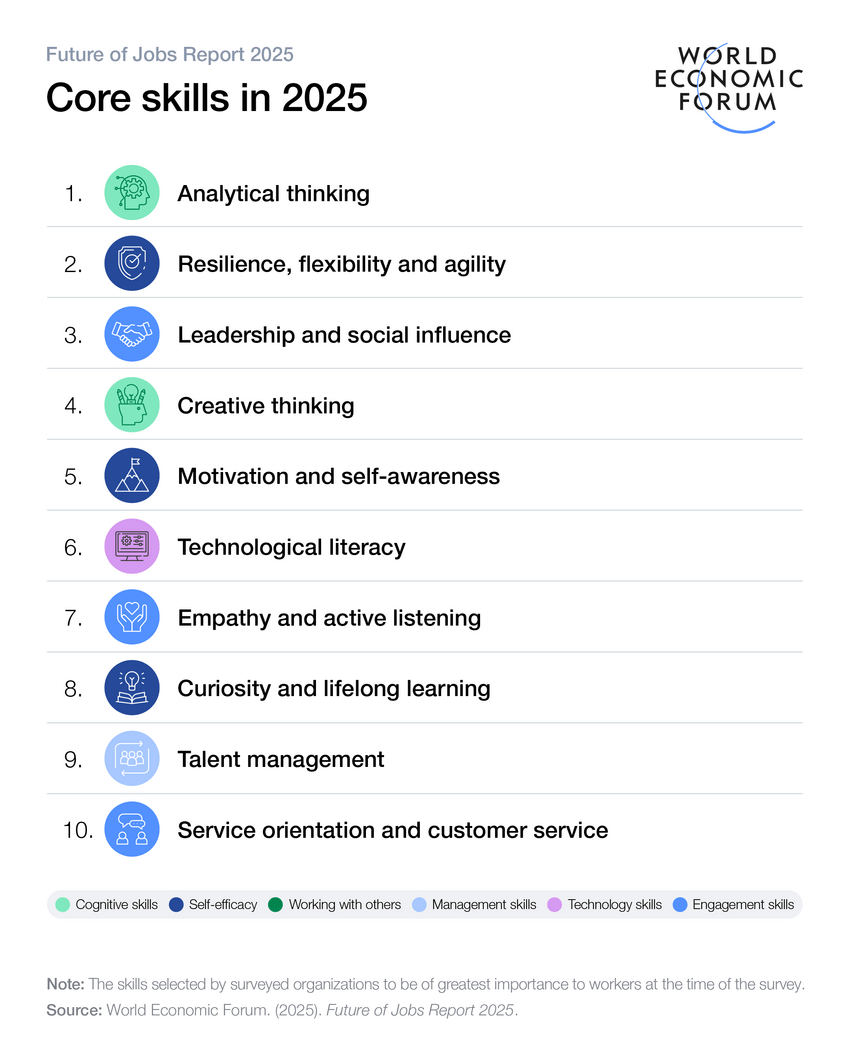
The World Economic Forum (2025) Future Skills Report suggests the core skills in demand are those in the figure below. This is a good starting place to consider your skills, but do take the time to look at a variety of of job adverts in your chosen field to gain an understanding of the skills that are requred.
The report shows that 69% of UK organisations placed resilience, flexibility and agility in the top five skills. Resilience is an important life skill and one to note as you may not get the first job you apply for and you need to keep trying. This is where getting feedback from family, peers or your careers and employability adviser at university, as they can help to check and even make further suggestions to enhance your LinkedIn profile, CV, cover letter and/or application form.
Projects
Add projects you have led or contributed to, and in particular those during work placements, summer internships or employer-informed university projects. Demonstrate the skills you have and are applying to the project.
Volunteering and extracurricular activities
This is a valuable way to make you stand out. Employers are looking for individuals with real-world experience and the development of valuable transferable skills like communication and teamwork. This can complement any part-time work experience you have.
LinkedIn recommendations
If you have work experience, reach out to your colleagues and ask them if they would be happy to give you a recommendation. These will allow connections to validate strengths shown on your profile and endorse your experience. If as a student you engage with roles such as a student rep, student ambassador or student researcher, reach out to your academic lead to see if they would be happy to give you a recomendation for the work you have done.
Make Connections
This may seem obvious, but over time you should aim to develop your connections beyond those you immediately know and work with. For example if you have attended a Careers Fair at university and talked to an employee representing a company you are interested in working for. You could follow this up by sending a personalised connection request saying for example “It was good to meet you at the recent Careers event… Thank you for the advice.”
You can also follow Companies on LinkedIn. This will give you updates on information shared by those organisations. Employers want to find applicants that have done their research and know as much as they can about the organisation. When you follow a company it will also highlight if you are connected to someone who works there. This may be a peer you met at university or a previous job, who could be a great contact to reach out to and find out more about the organisation.
References
Beckingham, S. (2023a). Professionalism and Online Presence. In: Carter, J., O’Grady, M., and Rosen, C. (eds) Higher Education Computer Science: A Manual of Practical Approaches 2nd edition. Springer, Cham. https://doi.org/10.1007/978-3-031-29386-3_18
Beckingham, S. (2023b). Baseline Skills—Scaffolding Soft Skills Development Within the Curriculum. In: Carter, J., O’Grady, and M., Rosen, C. (eds) Higher Education Computer Science: A Manual of Practical Approaches 2nd edition. Springer, Cham. https://doi.org/10.1007/978-3-031-29386-3_17
Beckingham, S. (2019) Developing a professional online presence and effective network. In C. Rowell (Ed). Social Media in Higher Education: Case Studies, Reflections and Analysis. Open Book Publishers. https://doi.org/10.11647/OBP.0162.03
LinkedIn Help (nd) LinkedIn help for students. https://students.linkedin.com/content/me/students/en-us
National Careers Service (nd) The STAR Method. https://nationalcareers.service.gov.uk/careers-advice/interview-advice/the-star-method
University Alliance (2024) To what degree: Understanding what UK businesses look for in graduates. https://www.unialliance.ac.uk/2024/08/14/towhatdegree/
World Economic Forum (2025) Core skills in 2025. https://www.weforum.org/publications/the-future-of-jobs-report-2025/infographics-94b6214b36/
Resource
The Project Based Learning (PjBL) Toolkit
https://project-based-learning-toolkit.com/

 Sue Beckingham





 Social Media for Learning